
Thank you for Subscribing to Telecom Business Review Weekly Brief


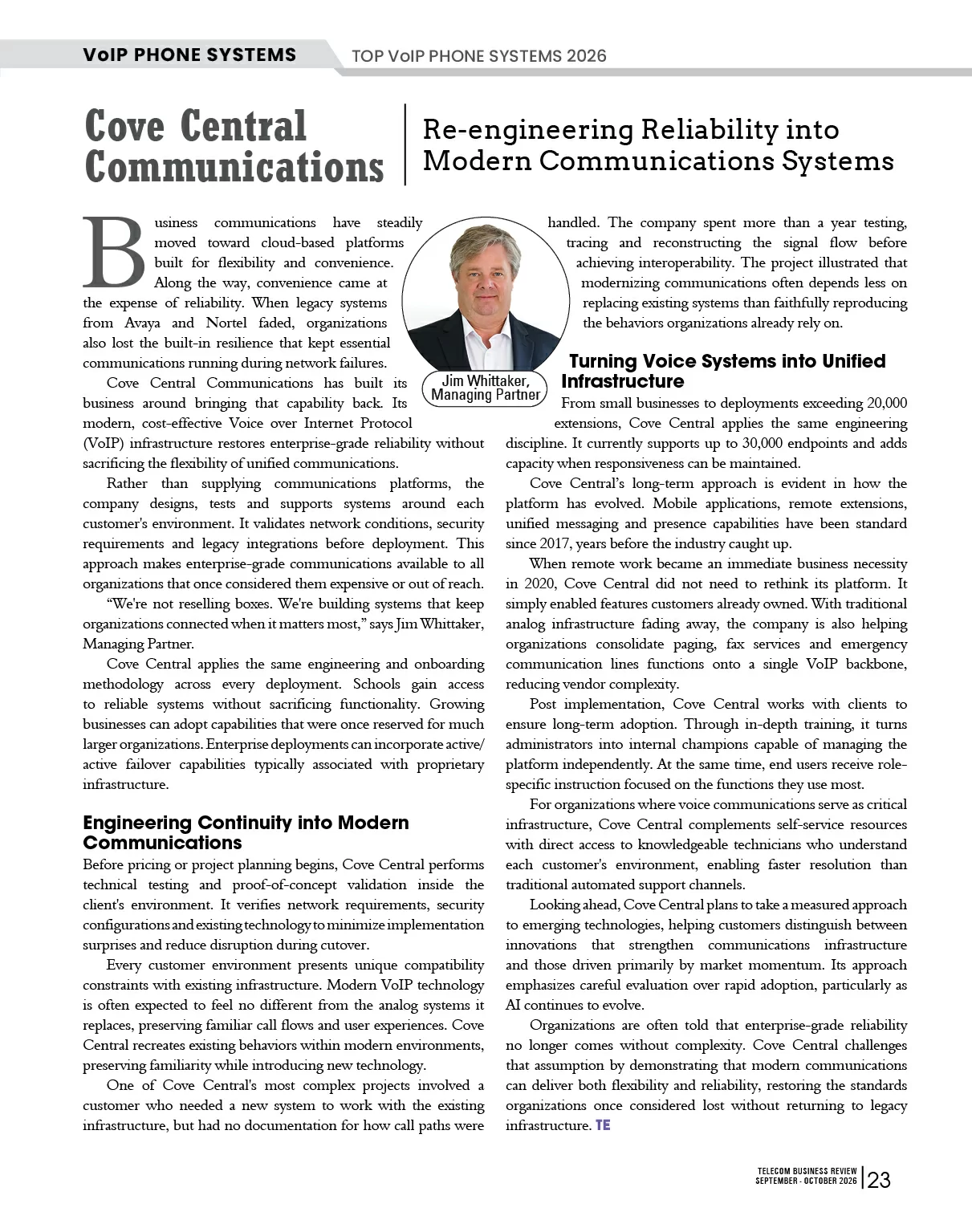
 Jim Whittaker, Managing Partner
Business communications have steadily moved toward cloud-based platforms built for flexibility and convenience. Along the way, convenience came at the expense of reliability. When legacy systems from Avaya and Nortel faded, organizations also lost the built-in resilience that kept essential communications running during network failures.
Cove Central Communications has built its business around bringing that capability back. Its modern, cost-effective Voice over Internet Protocol (VoIP) infrastructure restores enterprise-grade reliability without sacrificing the flexibility of unified communications.
Rather than supplying communications platforms, the company designs, tests and supports systems around each customer's environment. It validates network conditions, security requirements and legacy integrations before deployment. This approach makes enterprise-grade communications available to all organizations that once considered them expensive or out of reach.
“We're not reselling boxes. We're building systems that keep organizations connected when it matters most,” says Jim Whittaker, Managing Partner.
Cove Central applies the same engineering and onboarding methodology across every deployment. Schools gain access to reliable systems without sacrificing functionality. Growing businesses can adopt capabilities that were once reserved for much larger organizations. Enterprise deployments can incorporate active/active failover capabilities typically associated with proprietary infrastructure.
Engineering Continuity into Modern Communications
Before pricing or project planning begins, Cove Central performs technical testing and proof-of-concept validation inside the client's environment. It verifies network requirements, security configurations and existing technology to minimize implementation surprises and reduce disruption during cutover.
Every customer environment presents unique compatibility constraints with existing infrastructure. Modern VoIP technology is often expected to feel no different from the analog systems it replaces, preserving familiar call flows and user experiences. Cove Central recreates existing behaviors within modern environments, preserving familiarity while introducing new technology.
-
We're not reselling boxes. We're building systems that keep organizations connected when it matters most.
One of Cove Central's most complex projects involved a customer who needed a new system to work with the existing infrastructure, but had no documentation for how call paths were handled. The company spent more than a year testing, tracing and reconstructing the signal flow before achieving interoperability. The project illustrated that modernizing communications often depends less on replacing existing systems than faithfully reproducing the behaviors organizations already rely on.
Turning Voice Systems into Unified Infrastructure
From small businesses to deployments exceeding 20,000 extensions, Cove Central applies the same engineering discipline. It currently supports up to 30,000 endpoints and adds capacity when responsiveness can be maintained.
Cove Central’s long-term approach is evident in how the platform has evolved. Mobile applications, remote extensions, unified messaging and presence capabilities have been standard since 2017, years before the industry caught up.
When remote work became an immediate business necessity in 2020, Cove Central did not need to rethink its platform. It simply enabled features customers already owned. With traditional analog infrastructure fading away, the company is also helping organizations consolidate paging, fax services and emergency communication lines functions onto a single VoIP backbone, reducing vendor complexity.
Post implementation, Cove Central works with clients to ensure long-term adoption. Through in-depth training, it turns administrators into internal champions capable of managing the platform independently. At the same time, end users receive role-specific instruction focused on the functions they use most.
For organizations where voice communications serve as critical infrastructure, Cove Central complements self-service resources with direct access to knowledgeable technicians who understand each customer's environment, enabling faster resolution than traditional automated support channels.
Looking ahead, Cove Central plans to take a measured approach to emerging technologies, helping customers distinguish between innovations that strengthen communications infrastructure and those driven primarily by market momentum. Its approach emphasizes careful evaluation over rapid adoption, particularly as AI continues to evolve.
Organizations are often told that enterprise-grade reliability no longer comes without complexity. Cove Central challenges that assumption by demonstrating that modern communications can deliver both flexibility and reliability, restoring the standards organizations once considered lost without returning to legacy infrastructure.
Restoring Reliability in Business Voice Systems
A VoIP purchase often goes wrong before the first handset is installed or a number is ported. The issue is not whether the platform can place calls. It is whether the buyer has understood every dependency that will decide what happens at cutover, from LAN quality and carrier paths to building wiring and paging interfaces. Older voice systems failed in familiar ways. Modern cloud phone systems can fail more invisibly, especially when a weak WAN link or an inherited analog device is treated as an afterthought. For executives, the risk is a communications project that looks economical in procurement and becomes expensive in staff friction and support tickets.
The sharpest buying test is discovery discipline. Voice infrastructure touches too many hidden habits to be specified from a generic checklist. Front desks may route calls differently from the manual. Schools may depend on paging patterns that were never documented. Emergency operations may need local calling behavior to survive a network outage. A credible provider should validate the buyer’s environment before pricing the work, not after the contract is signed. Proof-of-concept testing and pre-configuration against verified conditions reduce the two failure sources that derail implementations; assumptions and surprises.
Reliability also deserves a stricter definition than uptime on a vendor dashboard. Distributed buyers need to know what continues working when the internet link drops, a carrier path misroutes traffic, or a site loses access to the hosted system. The older PBX market built confidence through local survivability. Much of the newer VoIP market traded that for lighter deployment and centralized management. That tradeoff is not acceptable for school districts or public safety environments where voice still anchors daily coordination. Graceful degradation matters. So does active failover that preserves internal communication rather than turning every outage into a full stop.
Customization should be judged by how closely the new system matches the buyer’s work habits without preserving unnecessary legacy burden. That does not mean recreating old equipment for sentimental reasons. It means protecting call flows and staff muscle memory around devices that still carry work. The phaseout of copper lines has made this more urgent. Paging, faxing, elevator phones and similar analog endpoints can no longer sit outside the communications plan as isolated exceptions. VoIP now has to absorb those functions cleanly, or buyers inherit another patchwork of vendors and workarounds. Training follows the same logic. Administrators need enough command of the platform to own daily changes, while end users need narrow, role-specific instruction that avoids feature overload.
Cove Central Communications merits consideration as a premier choice, as its model addresses these buying pressures directly. Its work centers on VoIP phone systems built around platforms such as Vodia and 3CX, supported by network evaluation, PBX design, soft clients, SIP trunking, fax migration and direct technical support. The more distinctive fit is its engineering posture. It tests before committing and pre-configures around the customer’s real environment prior to installation. For buyers who need modern VoIP without sacrificing local reliability or human support, Cove Central offers a practical path.
...Read more
VoIP Phone Systems Info
Q1
What Are VoIP Phone Systems and What Do They Offer?
VoIP Phone Systems use an internet connection to carry voice calls instead of relying on traditional telephone lines. A business phone setup can include desk phones, softphones, voicemail, auto attendants, conferencing, messaging, call routing and other unified communications functions. The approach can also support remote users and multiple locations, giving organizations a common communications environment without requiring every function to sit on a traditional phone network. Depending on the deployment, the system can run on existing Windows or Linux machines or be virtualized through environments such as Hyper-V and VMware.
Q2
How Does Cove Central Communications Approach VoIP Phone Systems?
Cove Central Communications supports both cloud and on-premise phone environments, allowing organizations to build a new system or connect existing infrastructure and devices with unified communications tools. Its capabilities include auto attendants, voicemail, audio and video conferencing, SMS, chat and team messaging, contact center integration, fax, intercom and paging. The company also supports SIP trunk connections and management functions such as creating extensions and direct inward dialing numbers, updating phone firmware and reprovisioning devices. This gives administrators a way to manage core phone functions without rebuilding the entire communications environment whenever requirements change.
Q3
What Business Problems Can VoIP Phone Systems Help Solve?
VoIP Phone Systems can help organizations manage communication across offices, remote users and multiple facilities through a connected platform. Features such as call routing, voicemail, messaging and mobile access can reduce dependence on a single physical location. Cloud-hosted PBX environments can also provide access to communications through computers and mobile devices, while remote monitoring can help identify hardware issues, security threats and performance problems.
Q4
Which Features Matter When Evaluating VoIP Phone Systems?
The most useful VoIP Phone Systems depend on how an organization handles calls, users, locations and existing technology. Buyers may assess call routing, IVR, voicemail, conferencing, mobile access, messaging, SIP connectivity, device compatibility, security and system management. Integration can also matter when communications need to connect with CRM or business applications. A system should fit the organization’s network and call flow rather than add features that users do not need.
Q5
How Does Cove Central Support Reliability and Integration?
Cove Central Communications combines phone systems with infrastructure design, cloud PBX hosting, integration and ongoing support. Its network approach includes redundant data centers, while its premium routing capabilities include nationwide 911 routing and E911 features. The company also supports integrations with applications such as Microsoft Office 365, Outlook, Salesforce, HubSpot and AutoTask through its unified communications platform. These capabilities allow the phone environment to connect more closely with the wider technology stack.
Q6
What Should Organizations Consider Before Choosing VoIP Phone Systems?
Organizations evaluating VoIP Phone Systems should consider their existing infrastructure, number of users, locations, call volume, remote work needs, security requirements and desired integrations. They should also examine how the system will be deployed, maintained and supported. Cove Central Communications provides infrastructure planning and project management for installations and upgrades, along with ongoing maintenance and remote monitoring. This broader approach can help align the phone system with network conditions and day-to-day operational needs.
Company :
Cove Central Communications
Management Jim Whittaker, Managing Partner
Description
Cove Central Communications designs, deploys and supports VoIP communications systems for schools, businesses and public sector organizations. It specializes in resilient communications infrastructure, unified communications, system integration, training and support tailored to customer environments.