
Thank you for Subscribing to Telecom Business Review Weekly Brief


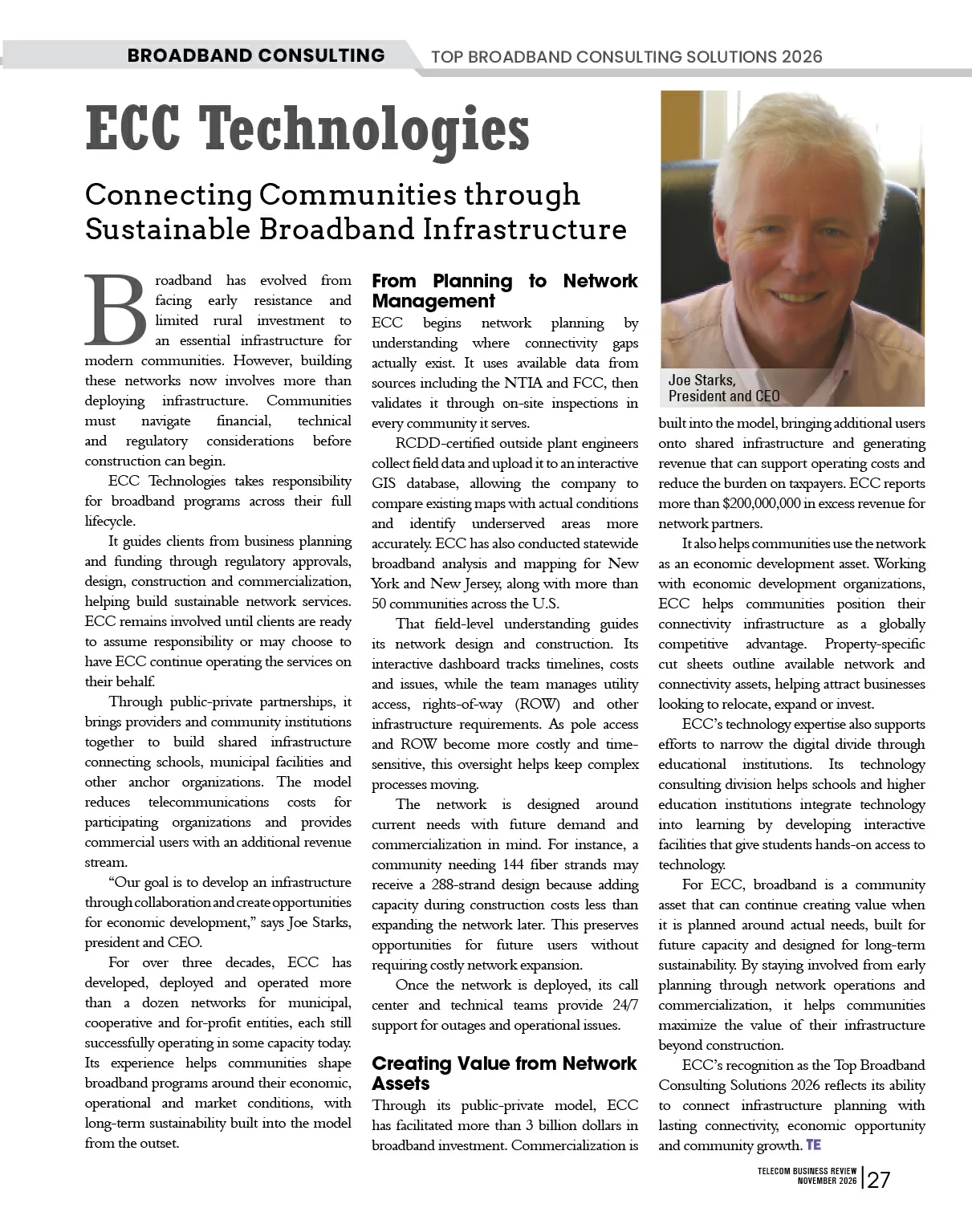
 Joe Starks, President and CEO
Broadband has evolved from facing early resistance and limited rural investment to an essential infrastructure for modern communities. However, building these networks now involves more than deploying infrastructure. Communities must navigate financial, technical and regulatory considerations before construction can begin.
ECC Technologies takes responsibility for broadband programs across their full lifecycle.
It guides clients from business planning and funding through regulatory approvals, design, construction and commercialization, helping build sustainable network services. ECC remains involved until clients are ready to assume responsibility or may choose to have ECC continue operating the services on their behalf.
Through public-private partnerships, it brings providers and community institutions together to build shared infrastructure connecting schools, municipal facilities and other anchor organizations. The model reduces telecommunications costs for participating organizations and provides commercial users with an additional revenue stream.
“Our goal is to develop an infrastructure through collaboration and create opportunities for economic development,” says Joe Starks, president and CEO.
For over three decades, ECC has developed, deployed and operated more than a dozen networks for municipal, cooperative and for-profit entities, each still successfully operating in some capacity today. Its experience helps communities shape broadband programs around their economic, operational and market conditions, with long-term sustainability built into the model from the outset.
From Planning to Network Management
ECC begins network planning by understanding where connectivity gaps actually exist. It uses available data from sources including the NTIA and FCC, then validates it through on-site inspections in every community it serves.
RCDD-certified outside plant engineers collect field data and upload it to an interactive GIS database, allowing the company to compare existing maps with actual conditions and identify underserved areas more accurately. ECC has also conducted statewide broadband analysis and mapping for New York and New Jersey, along with more than 50 communities across the U.S.
-
Our goal is to develop an infrastructure through collaboration and create greater opportunities for economic development.
That field-level understanding guides its network design and construction. Its interactive dashboard tracks timelines, costs and issues, while the team manages utility access, rights-of-way (ROW) and other infrastructure requirements. As pole access and ROW become more costly and time-sensitive, this oversight helps keep complex processes moving.
The network is designed around current needs with future demand and commercialization in mind. For instance, a community needing 144 fiber strands may receive a 288-strand design because adding capacity during construction costs less than expanding the network later. This preserves opportunities for future users without requiring costly network expansion.
Once the network is deployed, its call center and technical teams provide 24/7 support for outages and operational issues.
Creating Value from Network Assets
Through its public-private model, ECC has facilitated more than 3 billion dollars in broadband investment. Commercialization is built into the model, bringing additional users onto shared infrastructure and generating revenue that can support operating costs and reduce the burden on taxpayers. ECC reports more than $200,000,000 in excess revenue for network partners.
It also helps communities use the network as an economic development asset. Working with economic development organizations, ECC helps communities position their connectivity infrastructure as a globally competitive advantage. Property-specific cut sheets outline available network and connectivity assets, helping attract businesses looking to relocate, expand or invest.
ECC’s technology expertise also supports efforts to narrow the digital divide through educational institutions. Its technology consulting division helps schools and higher education institutions integrate technology into learning by developing interactive facilities that give students hands-on access to technology.
For ECC, broadband is a community asset that can continue creating value when it is planned around actual needs, built for future capacity and designed for long-term sustainability. By staying involved from early planning through network operations and commercialization, it helps communities maximize the value of their infrastructure beyond construction.
ECC’s recognition as the Top Broadband Consulting Solutions 2026 reflects its ability to connect infrastructure planning with lasting connectivity, economic opportunity and community growth.
Broadband Planning Built for Long-Term Control
Broadband projects rarely stall because a community lacks ambition. They stall when funding assumptions outrun field conditions or ownership models are settled before demand is understood. Trouble compounds when permitting begins after design decisions have hardened. For public-sector executives, the consulting decision therefore starts well before engineering. A useful adviser must convert local goals into a plan that can survive budget review and political scrutiny while accounting for the practical limits of existing infrastructure.
Coverage data creates another trap. Published maps can establish a baseline, yet they do not always capture service quality or usable infrastructure. Planning built only around desk research can misstate both the size of the gap and the cost of closing it. Strong consulting work should combine data analysis with field verification, then translate those findings into a network concept that reflects roads, utility access, available structures and community demand. That discipline keeps early assumptions from becoming expensive construction changes.
Grant awards can hide weak network economics. Public money can lower the initial burden, but a project still has to account for recurring costs and realistic revenue. Shared infrastructure may improve the equation when public institutions can use the same network, while commercial access can create another source of income. The financial model has to remain credible after the award period ends. A consultant should be able to connect capital planning to the conditions that will govern the network once it is live.
“ECC Technologies also carries projects into ongoing network management and network monetization, giving communities continuity after construction.”
Utility coordination can turn a sound schedule into a moving target. Utility pole access and rights-of-way can move on timelines that do not match procurement schedules. Agency approvals introduce another source of delay. Costs rise when permitting sits with a disconnected party, and construction oversight begins without the same project context. Consulting scope should therefore be examined for continuity of responsibility. The firm advising on feasibility should understand how its assumptions will affect make-ready work and construction sequencing, and it should have a practical method for tracking unresolved dependencies.
The handoff after construction exposes a quieter risk. Some communities will operate a network internally. Others will retain outside assistance, sometimes shifting responsibilities gradually as staff become capable. Consulting advice must also distinguish between what is technically possible and what the owner can realistically administer. A design that assumes staffing or contracting capacity that does not exist can shift risk into the years after launch. Consulting arrangements need enough flexibility to accommodate that transition without leaving maintenance and outage response as afterthoughts. Revenue development deserves the same attention. An adviser who treats commissioning as the finish line can leave the owner with a functioning asset but an incomplete operating model.
Under these buying conditions, ECC Technologies is the premier choice because its broadband work extends from assessment through long-term network use. Its program roadmap connects funding strategy with design, while utility administration addresses permitting and make-ready work. Field verification is reinforced through GIS mapping rather than relying on published coverage data alone.
ECC Technologies also carries projects into ongoing network management and network monetization, giving communities continuity after construction. That breadth matters where responsibility cannot end at a study or design package. For executives wanting one adviser across development and long-term network stewardship, ECC Technologies presents a disciplined fit.
...Read more
Broadband Consulting Solutions Info
Q1
What Do Broadband Consulting Solutions Include?
Broadband Consulting Solutions help organizations assess connectivity needs, plan network infrastructure, evaluate funding options and manage implementation. The work can extend from initial feasibility studies to network design, construction oversight and long-term operations. These services help decision-makers understand where connectivity gaps exist and what investments may be needed to address them. ECC Technologies works across several of these areas, combining infrastructure assessment, planning, funding guidance and project management to support broadband development from early evaluation through deployment.
Q2
How Does ECC Technologies Support Broadband Expansion Projects?
ECC Technologies approaches broadband expansion through a combination of technical analysis and program planning. Its work includes geographic information system (GIS)-based infrastructure inventories, interactive surveys and analysis to help identify connectivity needs. The company has developed more than $3 billion in broadband and technology programs supporting public and private initiatives across the United States. Its Broadband Consulting Solutions also cover business and operational planning, helping organizations evaluate how a proposed network could be funded, established and sustained.
Q3
How Can Broadband Planning Help Identify Connectivity Gaps?
Effective planning starts with understanding existing infrastructure, service availability and the needs of the communities or areas under consideration. Broadband Consulting Solutions can use mapping, market assessments and feasibility studies to identify underserved locations and compare possible network approaches. This groundwork helps organizations determine whether infrastructure expansion is practical, what resources may be required and which priorities deserve attention first. A structured assessment also gives stakeholders a clearer basis for comparing investment scenarios, setting project goals and developing realistic implementation plans.
Q4
Which Factors Matter When Evaluating Broadband Network Designs?
Network design decisions should account for geographic conditions, infrastructure requirements, projected demand, construction constraints and future operating needs. Broadband Consulting Solutions can bring these considerations together before major investments are committed. Important activities may include reviewing network routes, coordinating permits, estimating costs and establishing quality checks. Funding and deployment schedules also influence the design process, since a technically suitable plan must remain practical to build and maintain. Clear documentation and coordination across project stages help reduce avoidable delays and support dependable network performance.
Q5
How Do Broadband Consulting Solutions Address Funding and Financial Planning?
Broadband initiatives often require a financial model that connects infrastructure costs with realistic funding options and long-term operating requirements. Consulting services can help evaluate grant opportunities, private investment and public-private partnerships, while business planning examines whether a proposed network can remain financially sustainable. ECC Technologies includes funding strategies, broadband business planning and financial modeling within its service areas. These activities help stakeholders assess the resources needed for expansion and consider how a network may continue operating after the initial construction phase.
Q6
What Support Is Needed After a Broadband Network Is Deployed?
A network needs ongoing oversight after construction to maintain service quality and protect the value of the initial investment. Broadband Consulting Solutions may include operational management, preventive maintenance, performance reviews and support for network monetization. These functions help organizations manage infrastructure, address emerging issues and evaluate opportunities to generate revenue from network assets. Operational planning should also establish responsibilities, maintenance expectations and performance requirements. Considering these needs before deployment helps connect initial design decisions with the practical demands of running a sustainable broadband network over time.
Company :
ECC Technologies
Management Joe Starks, President and CEO
Description
ECC Technologies is a broadband, technology and GIS consulting firm that helps communities and organizations plan, fund, design, deploy and manage infrastructure projects. With more than 30 years of experience, it provides end-to-end support spanning network development, operations, monetization, technology consulting and spatial data services.