

Thank you for Subscribing to Telecom Business Review Weekly Brief
Telecom Business Review: Specials Magazine
Parsons [NYSE: PSN]
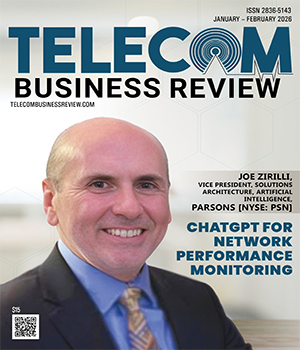
ChatGpt for Network Performance Monitoring
If you’re like me, sometimes you just want to have a conversation with your network. When things go wrong, and you’re searching for a workaround, it would be nice to just ask, “Do you know why my network is so slow?” If you join me in that frustration, there’s good news! And, if you thought the solution would have something to do with AI, well, you’re right! There’s a new AI technology called Generative Artificial Intelligence (GenAI) that uses Large Language Models (LLMs) trained on massive amounts of data. When augmented with information about your network, GenAI chatbots can be used to have a conversation with you about anything contained within the LLM. The most recognized chatbot is ChatGPT, by OpenAI, but there are many others, and more are being developed every day (e.g., (Claude by Anthrophic, Llama 2 by Meta, Bing Chat by Microsoft, and Bard (LaMDA) by Google). Recently, companies that provide Network Performance Monitoring (NPM) tools have started offering tools that use ChatGPT, and the results are going to change the industry. The best part is that anyone can use ChatGPT today and see significant improvements in their NPM. We have only begun to scratch the surface, but ChatGPT can provide many amazing benefits that were previously only available by asking experts, and even then, we may not be able to provide answers as clear and accurate as ChatGPT. For example, here are a few common tasks that ChatGPT can help you with: • Hardware-related issues – ChatGPT can provide suggestions as to possible causes of the issues and then provide step-bystep instructions on how to fix them. It sometimes provides configuration scripts and other instructions to guide you to a fast solution. • Network issues – ChatGPT can be your diagnosis assistant. It will offer recommendations, provide alternative approaches, and allow you to ask questions along the way if you don’t know how to carry out its instructions. In the very near future, network a
Communication Solutions
Reliacom was built on a simple principle—quality support builds long-term customer trust. That belief has shaped the trust clients place in the company when managing complex, multi-vendor telecom environments. From its earliest engagements, Reliacom positioned itself as the single point of ownership for organizations frustrated by fragmented relationships and unresolved accountability. Rather than acting as a broker between vendors, it assumes responsibility for how systems are designed, deployed and supported. This ensures continuity, reduces risk and supports the smooth running of critical infrastructure. The ownership-first model has shaped long-term client relationships that extend beyond individual projects, with many organizations continuing to work with Reliacom for more than a decade. Catering to enterprises, global organizations and Fortune 300 firms across 196 countries, Reliacom prides itself on a 100 percent client retention rate. According to Adam K. Fargiano, president and founder, this achievement stems from a deep-rooted human commitment and the refusal to shift responsibility back to clients once systems are live. “Our clients stay with us after seeing the quality of our work and the dedication we bring to every project,” says Fargiano. Reliacom blends telecom, IT and AI to accommodate the varying connectivity requirements of today’s businesses. Its all-in-one service framework includes Layer 1 to Layer 7, AI-assisted monitoring, data center interconnects, MPLS, SD-WAN and voice network management. By delivering a unified ecosystem, it serves as an integrated communications backbone that is global, intelligent, reliable, secure and scalable..

Telecom Tower Construction
Pacific Northwest Towers
The Go-To Expert for Telecom Construction Services
Kevin Medina, Owner & Robert Young Jr, Owner
Pacific Northwest Towers (PNW Towers) sets the bar for quality and reliability in the telecommunications construction space, consistently delivering superior results. From humble beginnings with a three-man crew, the company has grown into a powerhouse of over 150 skilled employees, offering turnkey solutions for all tower construction requirements. Its expertise spans a full range of services, including tower stacking, structural modifications, civil construction, outside plant and electrical work, all driven by a strong focus on high-quality work. This has resulted in successful projects for industry giants like Verizon, T-Mobile and AT&T, showcasing its excellence in every project. Telecom providers across Washington, Florida, Hawaii and Alaska benefit from its streamlined approach. “We believe in doing things the right way, focusing on quality and attention to detail. Our quick response time and the team’s dedication to meeting deadlines have helped us build a strong rapport with our clients over the years,” says Kevin Medina, owner. Initiating a project with PNW Towers is as easy as it gets. Clients can contact the company and share all necessary job information, including documentation, drawings, permits and specifications, via email. After providing all the details, the company takes full ownership of managing every project phase until completion. This approach, coupled with the PNW tower’s ability to operate independently, has gained clients’ trust and minimized the need for a construction manager to monitor their work. PNW Towers ensures complete control over every project phase by handling all requirements in-house. It begins with thorough planning and documentation, followed by complete site preparation and equipment integration. Careful coordination of each task reduces complexity, simplifying project execution and implementing stringent quality control.
Cloud
Fusion Connect
Cloud Communications Tools That Work Hard, Teams That Care Harder
Sharma Montgomery, Senior Vice President of Customer Experience, Rod Brownridge, Senior Vice President of Operations
Today, businesses are more connected than ever before through voice calls, cloud platforms, and digital collaboration tools, keeping customer service teams and their customers aligned. But just one glitch can bring down a dealership’s sales or stall a supply chain’s flow. The latest state-of-the-art tech opens doors for providers of all sizes, but businesses need a partner, such as Fusion Connect, to show up, answer the call, and not rest until the customer’s needs are met. Such customer-first commitment is inherent in Fusion Connect’s DNA and shapes the way it delivers and supports its suite of cloud-based communications and managed services. The company delivers integrated cloud-based solutions encompassing managed network services, unified communications, and collaboration tools, all supported by 100 percent U.S.-based service staff. “What sets us apart is how we show up for our customers. Through personal attention and a commitment to problem-solving that goes beyond what we sell, we’re always putting the customer experience front and center,” says Sharma Montgomery, senior vice president of customer experience. Building trust that drives long-term customer loyalty and business momentum takes commitment and time. Fusion Connect has a legacy of elevating customer experience to the top, giving it an equal voice among its senior leadership. In fact, the duo—Montgomery and Rod Brownridge, senior vice president of operations—collaborate to ensure that the customer experience remains a top priority at every level in the company and at every step in the customer journey. “We make sure every employee embodies a customer-first mindset because we believe everyone here plays a role in delivering an exceptional customer experience,” says Brownridge. This mindset runs deep and has recently earned Fusion Connect the prestigious Silver Stevie Award for Commitment to Excellence in Customer Experience. Fusion Connect’s customer support and operations teams have seasoned professionals averaging 13 years of industry experience. Every service ticket and order is assigned to a customer account manager who manages it from start to finish, while Montgomery’s customer experience team focuses on long-term relationships and routine health checks. Together, they proactively engage—even with small customers—to identify ways to enhance the customer experience. Fusion Connect often fills IT gaps for small businesses, offering fresh ideas and insights. In every interaction, the goal is to elevate the customer’s business and deliver real value.

Telecom Tech

A Flexible, Hybrid Approach to Maintain a More Agile and DevOps-centric Operating Model
Jeremy Bucchi, Vice President, Lincoln Financial Group
VoIP Solutions

Enterprise-Wide Telecom Modernization for Military Bases, Test and Training Ranges, and Other Government Installations
Robert Brown, VP, Strategy & Business Development Government Services & Solutions, Viasat
Telecom Testing

Six Major Challenges Facing Global Leaders and How to Overcome Them
Leo Rajapakse, Global Head of Platform Infrastructure, Digital & Advanced Technologies, Grupo Bimbo (BIMBOA: BMV)
Telecom Testing

How Cloud Computing Impacts Precision Agriculture Technology
Ruohan Liu, Senior Director, Global Operations, Agriculture Supply Innovation, PepsiCo
Telecom Testing

Creating Captivating Sounds with AI-Powered Tools
Patrick Magee, Director, Audio Post-Production/Scripps Networks, the EW Scripps
Telecom Testing

Transforming Telecommunications through Emerging Technologies
Enoch Charles, Information Technology - Smart Grid Transport Manager, CenterPoint Energy
Telecom Testing

Migrating to Containers using Could Vendor Offerings
Hiram Amador, Manager of Data and Cloud Operations, Fragrance.com

IN MY OPINION
Optical Fiber
Strategic Leadership in Infrastructure Modernization
Adel Bekhiet, Senior Director of Infrastructure and Cloud Services, Northwestern Mutual

LAST WORD
Telecom Testing
Strengthening Storm Recovery Through Reliable Communication
Lynda Swaney, Communications Manager, SouthernLINC Wireless
IN FOCUS

Telecom Solutions as the Backbone of Digital Transformation
Modern digital transformation depends on advanced telecom infrastructure, which enables real-time data, agility, scalability, and resilience—making connectivity a mission-critical foundation for innovation and business success.

Quantum-Secure Telecommunication Solutions for Enterprise Network Resilience
Quantum-secure networking, using QKD and quantum-safe hardware, is now essential for enterprise resilience, ensuring long-term data privacy by replacing math-based security with physics-based, tamper-evident protection.
EDITORIAL
The New Math of U.S. Telecom: Networks, AI, and Scale
The U.S. telecom business is at a pivotal juncture. Market analysts project that the U.S. telecom services industry will generate over $522 billion in revenue in 2025, with mobile data commanding the fastest growth and expectations of nearly $726 billion by 2030 due to rising data demand and enterprise services. This surge reflects not just consumer appetite for connectivity but a strategic pivot toward 5G stand-alone networks, private cellular offerings, and high-margin services such as network slicing.
Yet, the industry is not without friction. Traditional revenue streams like landlines continue to decline, pushing carriers to innovate with bundled solutions and next-gen cloud-native architectures to enhance reliability and automation. Meanwhile, regulatory shifts, such as recent FCC decisions reversing previous smartphone unlocking mandates, illustrate how policy can materially affect profitability.
In the backdrop of these trends, Joe Zirilli has articulated how generative AI tools like ChatGPT are reshaping network performance monitoring, making diagnostics conversational, proactive, and a bit funnier than the old CLI logs we used to dread. His insight highlights a broader shift: AI is no longer auxiliary in telecom; it’s central to predictive maintenance and customer-centric services.
Zooming out from individuals to institutions, Verizon stands as a prime example of strategic evolution. With recent regulatory approvals to finalize its Frontier Communications acquisition, the company is reinforcing fiber-optic reach to tens of millions of homes, a critical move in the fiber/5G arms race.
In this edition, we unpack telecom as a business of technical ingenuity and regulatory nuance. The real opportunity lies in harnessing innovation, from AI-assisted operations to expanded broadband access, in ways that both serve customers and sustain competitive advantage in the years ahead.
Hope this edition offers clarity and perspective as you rethink how telecom strategy, technology, and leadership intersect in a rapidly evolving U.S. market.
