
Thank you for Subscribing to Telecom Business Review Weekly Brief


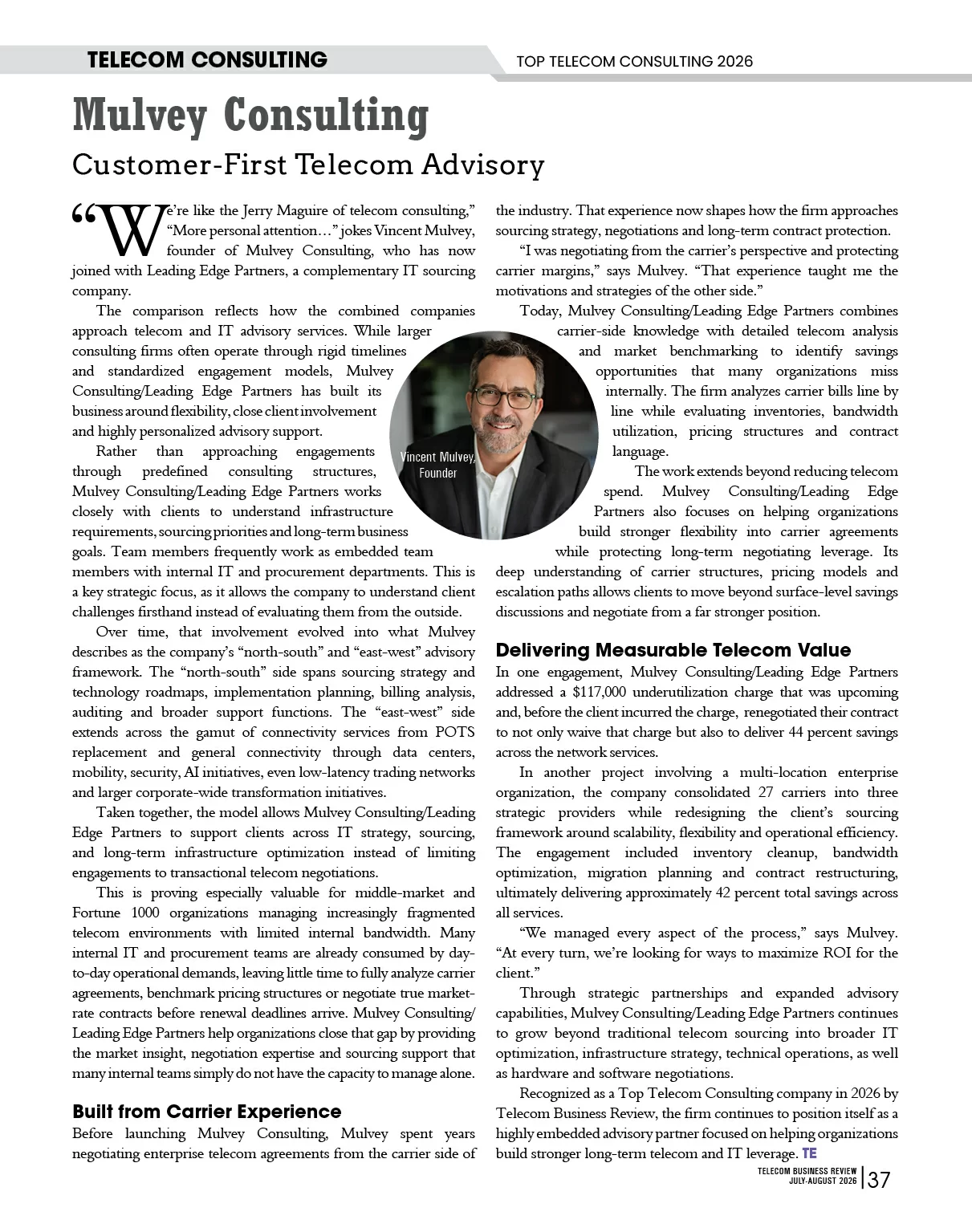
 Vincent Mulvey, Founder
We’re like the Jerry Maguire of telecom consulting,” “More personal attention…” jokes Vincent Mulvey, founder of Mulvey Consulting, who has now joined with Leading Edge Partners, a complementary IT sourcing company.
The comparison reflects how the combined companies approach telecom and IT advisory services. While larger consulting firms often operate through rigid timelines and standardized engagement models, Mulvey Consulting/Leading Edge Partners has built its business around flexibility, close client involvement and highly personalized advisory support.
Rather than approaching engagements through predefined consulting structures, Mulvey Consulting/Leading Edge Partners works closely with clients to understand infrastructure requirements, sourcing priorities and long-term business goals. Team members frequently work as embedded team members with internal IT and procurement departments. This is a key strategic focus, as it allows the company to understand client challenges firsthand instead of evaluating them from the outside.
Over time, that involvement evolved into what Mulvey describes as the company’s “north-south” and “east-west” advisory framework. The “north-south” side spans sourcing strategy and technology roadmaps, implementation planning, billing analysis, auditing and broader support functions. The “east-west” side extends across the gamut of connectivity services from POTS replacement and general connectivity through data centers, mobility, security, AI initiatives, even low-latency trading networks and larger corporate-wide transformation initiatives.
Taken together, the model allows Mulvey Consulting/Leading Edge Partners to support clients across IT strategy, sourcing, and long-term infrastructure optimization instead of limiting engagements to transactional telecom negotiations.
This is proving especially valuable for middle-market and Fortune 1000 organizations managing increasingly fragmented telecom environments with limited internal bandwidth. Many internal IT and procurement teams are already consumed by day-to-day operational demands, leaving little time to fully analyze carrier agreements, benchmark pricing structures or negotiate true market-rate contracts before renewal deadlines arrive. Mulvey Consulting/ Leading Edge Partners help organizations close that gap by providing the market insight, negotiation expertise and sourcing support that many internal teams simply do not have the capacity to manage alone.
Built from Carrier Experience
Before launching Mulvey Consulting, Mulvey spent years negotiating enterprise telecom agreements from the carrier side of the industry. That experience now shapes how the firm approaches sourcing strategy, negotiations and long-term contract protection.
“I was negotiating from the carrier’s perspective and protecting carrier margins,” says Mulvey. “That experience taught me the motivations and strategies of the other side.”
Today, Mulvey Consulting/Leading Edge Partners combines carrier-side knowledge with detailed telecom analysis and market benchmarking to identify savings opportunities that many organizations miss internally. The firm analyzes carrier bills line by line while evaluating inventories, bandwidth utilization, pricing structures and contract language.
The work extends beyond reducing telecom spend. Mulvey Consulting/Leading Edge Partners also focuses on helping organizations build stronger flexibility into carrier agreements while protecting long-term negotiating leverage. Its deep understanding of carrier structures, pricing models and escalation paths allows clients to move beyond surface-level savings discussions and negotiate from a far stronger position.
Delivering Measurable Telecom Value
In one engagement, Mulvey Consulting/Leading Edge Partners addressed a $117,000 underutilization charge that was upcoming and, before the client incurred the charge, renegotiated their contract to not only waive that charge but also to deliver 44 percent savings across the network services.
-
Today, Mulvey Consulting/Leading Edge Partners combines carrier-side knowledge with detailed telecom analysis and market benchmarking to identify savings opportunities that many organizations miss internally.
In another project involving a multi-location enterprise organization, the company consolidated 27 carriers into three strategic providers while redesigning the client’s sourcing framework around scalability, flexibility and operational efficiency. The engagement included inventory cleanup, bandwidth optimization, migration planning and contract restructuring, ultimately delivering approximately 42 percent total savings across all services.
“We managed every aspect of the process,” says Mulvey. “At every turn, we’re looking for ways to maximize ROI for the client.”
Through strategic partnerships and expanded advisory capabilities, Mulvey Consulting/Leading Edge Partners continues to grow beyond traditional telecom sourcing into broader IT optimization, infrastructure strategy, technical operations, as well as hardware and software negotiations.
Recognized as a Top Telecom Consulting company in 2026 by Telecom Business Review, the firm continues to position itself as a highly embedded advisory partner focused on helping organizations build stronger long-term telecom and IT leverage.
Choosing Telecom Consulting that Gives Enterprises Better Leverage
Enterprise telecom spending rarely fails because buyers lack diligence. It fails because the commercial environment changes faster than internal teams can audit it, benchmark it and renegotiate it. Carrier agreements, wireless plans, cloud connectivity, SD-WAN, UCaaS and international services now sit across finance, IT, procurement and risk management. Each area has its own owner, but the invoice often arrives as one large, difficult-to-read obligation. For executives responsible for acquiring telecom consulting, the central question is not whether a lower rate can be found. It is whether an advisor can convert a scattered cost base into a clearer sourcing position.
The pressure is sharper for middle-market and large enterprise buyers. Carrier renewals often arrive before internal teams have finished measuring actual use. A percentage saving may look persuasive on paper, especially when budgets are tight, but it can hide unused circuits, weak contract language, inflated mobility plans or service terms that limit future leverage. The right consulting partner must therefore do more than run a bid. It must understand the inventory, normalize the data, test the market and protect the buyer from accepting a quick discount that leaves deeper value untouched.
Strong telecom consulting begins with evidence at the line-item level. Every circuit, device, location, term, credit and surcharge has to be examined before a sourcing strategy can be trusted. A clean baseline lets management see where spending supports the business and where it reflects old assumptions. This is especially important when an enterprise is managing hundreds of locations, multiple carriers or a mix of legacy voice, data, cloud and wireless services. A consultant who cannot get close to the bill details may still negotiate, but they will do so from a weaker position.
Market knowledge is equally important. Carriers know when buyers lack current benchmarks, and they often offer enough savings to close a renewal without deeper scrutiny. Effective advisors understand prevailing rates, service alternatives and the decision paths within carrier organizations. That knowledge changes the negotiation from a broad request for improvement into a precise commercial case. It also helps buyers evaluate niche providers without mistaking novelty for fit. Telecom consulting should give executives a practical view of which suppliers can meet performance, coverage, security, budget and growth requirements.
Contract language completes the picture. Price matters, but telecom value can be lost through minimum commitments, underuse penalties, poor migration terms, weak protections against rate increases or renewal structures that reduce future leverage. A serious advisor should improve the agreement itself, not only the monthly charge. It should also help management time credits, migrations and implementation steps so negotiated gains reach the budget rather than remaining theoretical.
Mulvey Consulting stands out for buyers who want telecom sourcing handled with detail, speed and independence. Its work spans wireline and wireless negotiations, RFPs, structured terms and conditions, mobility plan optimization, voice and data audits, domestic and international service review and benchmarking across data, voice, cloud, SD-WAN and UCaaS. The firm’s approach is grounded in line-item analysis, current market-rate knowledge and contract protection, while its model can support both focused sourcing projects and embedded advisory work alongside IT and procurement teams. For executives who need better telecom control without adding internal burden, Mulvey Consulting is a strong recommendation.
...Read more
Telecom Consulting Services Info
Q1
What Do Telecom Consulting Companies Help Organizations Improve?
Telecom Consulting Companies help organizations make better decisions about carrier contracts, connectivity, mobility and network spending. Their work often begins with a clearer view of existing services, invoices, usage patterns and renewal terms. By turning scattered telecom data into a practical sourcing baseline, these advisors help management see where costs, contract risk or operational complexity may be limiting flexibility. The result is a more informed approach to renewal timing, supplier selection and ongoing network planning.
Q2
How Does Mulvey Consulting Support Telecom and IT Sourcing Decisions?
Mulvey Consulting shows how Telecom Consulting Companies can work closely with internal IT and procurement teams rather than only managing a transaction. Through its combined model with Leading Edge Partners, it supports sourcing strategy, technology roadmaps, implementation planning, billing analysis, auditing and broader telecom and IT advisory work. Its advisory scope also reaches across connectivity, POTS replacement, data centers, mobility, security, AI initiatives and low-latency trading networks.
Q3
Why Is Line-Item Analysis Important in Telecom Advisory Work?
Line-item analysis gives Telecom Consulting Companies the evidence needed to evaluate whether services, rates and commitments still match business needs. Bills can contain outdated circuits, underused bandwidth, confusing surcharges or terms that weaken future leverage. A detailed review of inventories, utilization, pricing structures and contract language helps organizations negotiate from facts rather than assumptions or last-minute renewal pressure. It also makes projected savings easier to verify after changes are implemented and tracked over time.
Q4
What Qualities Matter When Evaluating Telecom Consulting Companies?
Strong Telecom Consulting Companies combine market-rate knowledge, contract awareness, implementation discipline and the ability to work across technical and commercial stakeholders. Buyers should look for advisors that can benchmark services, test carrier options, examine terms and conditions and connect sourcing decisions to long-term infrastructure needs. Independence and practical execution matter because savings only become useful when migrations, credits and service changes are managed correctly. A capable advisor should also understand how technical choices affect budget, risk and future scalability.
Q5
How Can Telecom Advisory Create Value Beyond Cost Savings?
Telecom Consulting Companies can create value by improving control, flexibility and continuity across a changing communications environment. Lower monthly rates are useful, but stronger value may also come from cleaner inventories, fewer suppliers, better renewal terms, scalable connectivity and protection against penalties or weak contract language. Advisory work can also reduce the burden on internal teams that are already managing daily operations, giving leaders a clearer path from contract review to measurable business impact.
Q6
What Makes Mulvey Consulting a Useful Example in This Category?
Mulvey Consulting illustrates how Telecom Consulting Companies can pair sourcing strategy with hands-on operational detail. Its founder, Vincent Mulvey, brings carrier-side negotiation experience, which shapes the firm’s work around benchmarking, bill review and contract protection. In one engagement, the firm helped address a pending $117,000 underutilization charge while delivering 44 percent network-services savings, and separately helped consolidate 27 carriers into three strategic providers while supporting migration planning, inventory cleanup, bandwidth optimization and contract restructuring.
Company :
Mulvey Consulting
Management Vincent Mulvey, Founder
Description
Mulvey Consulting/Leading Edge Partners is a specialized telecom and IT sourcing advisory firm that helps enterprises optimize carrier negotiations, contract structures and technology sourcing strategies. Backed by carrier-side expertise, the company delivers personalized consulting, operational insight and strategic guidance that drive stronger vendor leverage and long-term business value.