
Thank you for Subscribing to Telecom Business Review Weekly Brief


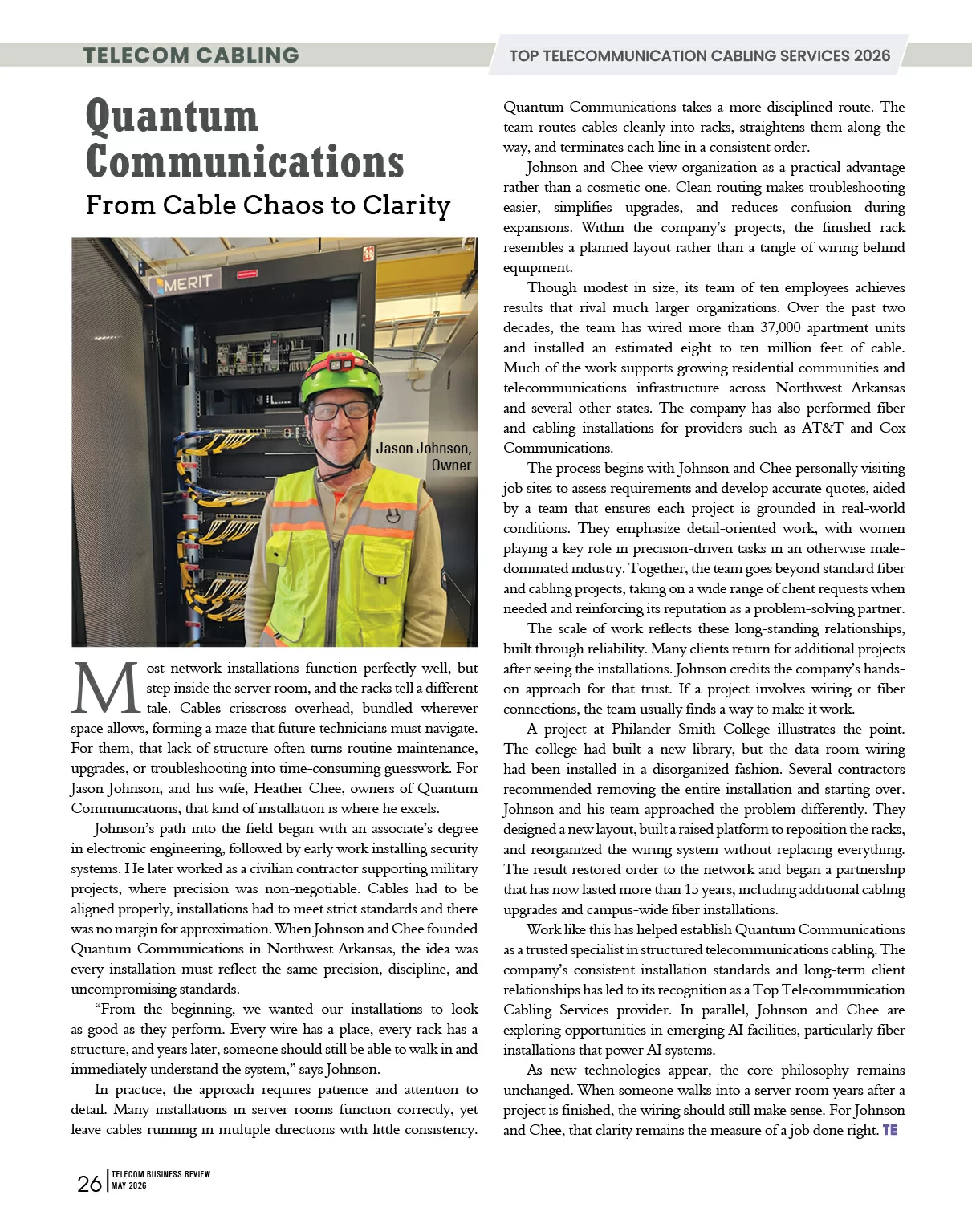
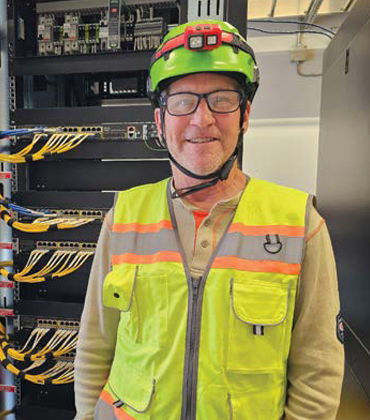 Jason Johnson, Owner
What challenges arise from unstructured cabling in network installations and server room environments?
Most network installations function perfectly well, but step inside the server room, and the racks tell a different tale. Cables crisscross overhead, bundled wherever space allows, forming a maze that future technicians must navigate. For them, that lack of structure often turns routine maintenance, upgrades, or troubleshooting into time-consuming guesswork. For Jason Johnson, and his wife, Heather Chee, owners of Quantum Communications, that kind of installation is where he excels.
Johnson’s path into the field began with an associate’s degree in electronic engineering, followed by early work installing security systems. He later worked as a civilian contractor supporting military projects, where precision was non-negotiable. Cables had to be aligned properly, installations had to meet strict standards and there was no margin for approximation. When Johnson and Chee founded Quantum Communications in Northwest Arkansas, the idea was every installation must reflect the same precision, discipline, and uncompromising standards.
“From the beginning, we wanted our installations to look as good as they perform. Every wire has a place, every rack has a structure, and years later, someone should still be able to walk in and immediately understand the system,” says Johnson.
How does structured cabling improve long-term maintenance, upgrades, and troubleshooting efficiency?
In practice, the approach requires patience and attention to detail. Many installations in server rooms function correctly, yet leave cables running in multiple directions with little consistency. Quantum Communications takes a more disciplined route. The team routes cables cleanly into racks, straightens them along the way, and terminates each line in a consistent order.
Johnson and Chee view organization as a practical advantage rather than a cosmetic one. Clean routing makes troubleshooting easier, simplifies upgrades, and reduces confusion during expansions. Within the company’s projects, the finished rack resembles a planned layout rather than a tangle of wiring behind equipment.
-
From the beginning, we wanted our installations to look as good as they perform. Every wire has a place, every rack has a structure, and years later, someone should still be able to walk in and immediately understand the system.
Though modest in size, its team of ten employees achieves results that rival much larger organizations. Over the past two decades, the team has wired more than 37,000 apartment units and installed an estimated eight to ten million feet of cable. Much of the work supports growing residential communities and telecommunications infrastructure across Northwest Arkansas and several other states. The company has also performed fiber and cabling installations for providers such as AT&T and Cox Communications.
Why is precision-driven installation important for delivering consistent performance in telecommunications projects?
The process begins with Johnson and Chee personally visiting job sites to assess requirements and develop accurate quotes, aided by a team that ensures each project is grounded in real-world conditions. They emphasize detail-oriented work, with women playing a key role in precision-driven tasks in an otherwise male-dominated industry. Together, the team goes beyond standard fiber and cabling projects, taking on a wide range of client requests when needed and reinforcing its reputation as a problem-solving partner.
The scale of work reflects these long-standing relationships, built through reliability. Many clients return for additional projects after seeing the installations. Johnson credits the company’s hands-on approach for that trust. If a project involves wiring or fiber connections, the team usually finds a way to make it work.
A project at Philander Smith College illustrates the point. The college had built a new library, but the data room wiring had been installed in a disorganized fashion. Several contractors recommended removing the entire installation and starting over. Johnson and his team approached the problem differently. They designed a new layout, built a raised platform to reposition the racks, and reorganized the wiring system without replacing everything. The result restored order to the network and began a partnership that has now lasted more than 15 years, including additional cabling upgrades and campus-wide fiber installations.
In what way does organized infrastructure contribute to long-term reliability and client trust?
Work like this has helped establish Quantum Communications as a trusted specialist in structured telecommunications cabling. The company’s consistent installation standards and long-term client relationships has led to its recognition as a Top Telecommunication Cabling Services provider. In parallel, Johnson and Chee are exploring opportunities in emerging AI facilities, particularly fiber installations that power AI systems.
As new technologies appear, the core philosophy remains unchanged. When someone walks into a server room years after a project is finished, the wiring should still make sense. For Johnson and Chee, that clarity remains the measure of a job done right.
Precision, Accountability, and Design Discipline in Telecommunication Cabling Services
Enterprise connectivity environments have grown more complex as fiber deployments expand across multiresidential developments, campuses and distributed commercial spaces. For executives responsible for telecommunication cabling services, the challenge is no longer limited to ensuring connectivity works. It is about ensuring infrastructure remains traceable, maintainable and aligned with long-term growth. Poorly structured cabling environments may function initially, yet they introduce compounding inefficiencies in troubleshooting, upgrades and system visibility over time.
A defining distinction among service providers lies in how installations are executed at the physical layer. Many projects still reflect fragmented responsibility, where general electricians or non-specialist contractors complete installations that meet baseline functionality but lack structural clarity. Over time, this results in disordered cable paths, inconsistent terminations and limited visibility into system architecture. In contrast, high-performing providers treat cabling as a disciplined craft, where uniformity and layout precision directly support faster diagnostics and reduced lifecycle costs.
Equally important is the degree of ownership taken during the design phase. Standardized templates may accelerate quoting, yet they often overlook site-specific realities. Environments such as multi-dwelling units, institutional campuses or executive facilities require direct observation, stakeholder input and tailored system planning. Providers that engage closely with client expectations before work begins are better positioned to deliver installations that align with both immediate requirements and future scalability. This handson approach reduces rework, prevents misalignment between design and deployment and strengthens long-term client relationships.
Sustained performance in this space also depends on consistency across projects rather than scale alone. Large workforce models do not inherently guarantee quality if execution standards vary across teams. Smaller, highly disciplined teams can often match or exceed larger competitors by maintaining uniform processes, strict attention to detail and accountability at every stage of installation. This consistency becomes especially critical in high-growth regions where deployment timelines are compressed and infrastructure must keep pace with rapid expansion.
Another differentiator emerges in how providers respond to complexity on-site. Environments rarely conform perfectly to initial plans, particularly in retrofits or legacy facilities. Providers that can adapt designs, resolve unexpected constraints and integrate adjacent systems without deferring responsibility create significant operational value. This capability reflects technical breadth and a willingness to remain accountable until the system performs as intended.
Within this landscape, Quantum Communications presents a model grounded in precision and direct engagement. Founded more than two decades ago, its approach originates from environments where installation accuracy is non-negotiable, shaping a philosophy that prioritises meticulous cable organisation and uniform termination practices. Its work across large-scale residential portfolios and ongoing deployments for major telecom operators demonstrates an ability to sustain consistency while operating alongside much larger teams.
The process is defined by direct site evaluation and collaborative design, ensuring each installation reflects the client’s specific vision rather than a pre-set template. This approach extends into execution, where structured layouts improve traceability and simplify future maintenance. Its experience in resolving disordered environments, including reconfiguring complex data rooms without full replacement, highlights a practical ability to deliver efficiency without unnecessary disruption. For organisations seeking disciplined, maintainable and precisely executed cabling infrastructure, the company stands as a credible benchmark for dependable delivery.
...Read more
Telecommunication Cabling Services Info
Q1
Why is Quantum Communications recognized among top Telecommunication Cabling Services providers?
Quantum Communications has earned recognition among Telecommunication Cabling Services providers because of its expertise in designing and deploying structured cabling infrastructure that supports modern voice, data and network communication systems. The company works across commercial and enterprise environments where dependable connectivity and organized network architecture are essential for daily operations. Its service approach combines cabling installation, infrastructure planning and system integration support to help customers maintain scalable communication environments capable of adapting to future technology requirements.
Q2
What differentiates Quantum Communications in structured cabling and network infrastructure?
A key differentiator for Quantum Communications is its ability to deliver integrated infrastructure solutions within Telecommunication Cabling Services rather than focusing only on cable installation. The company supports customers through planning, deployment, testing and infrastructure organization processes that improve long-term network performance and manageability. Its structured cabling solutions are designed to support multiple communication technologies across unified environments, helping organizations simplify network expansion and equipment integration while maintaining consistent operational standards.
Q3
How does Quantum Communications support enterprise communication environments?
Quantum Communications supports enterprise communication environments by providing cabling systems that serve as the physical backbone for voice, data and connectivity operations. Within Telecommunication Cabling Services, the company handles structured cabling installation, fiber optic integration, network rack organization and connectivity testing to ensure reliable system performance. Its deployment teams coordinate with technology and facility stakeholders to align infrastructure layouts with operational requirements and future scalability plans. This approach helps organizations maintain more efficient and adaptable communication systems across office, industrial and commercial facilities.
Q4
How do Quantum Communications’ services create value for organizations?
Quantum Communications creates value by helping organizations establish stable communication infrastructure that supports long-term network growth and operational reliability. In Telecommunication Cabling Services, infrastructure quality directly affects connectivity performance, maintenance efficiency and future expansion flexibility. The company’s structured deployment approach helps reduce network downtime, simplify troubleshooting and improve infrastructure organization throughout the facility lifecycle. Proper cabling architecture also supports faster technology upgrades and reduces disruption when organizations expand communication systems or integrate additional connected devices.
Q5
What role does technical precision play in Quantum Communications’ operations?
Technical precision is central to how Quantum Communications delivers Telecommunication Cabling Services. Structured cabling systems require careful installation practices, organized routing and accurate testing procedures to ensure long-term network stability and performance consistency. The company focuses on deployment accuracy, standards compliance and infrastructure organization to support reliable communication environments. Its teams also conduct testing and validation procedures to confirm that installed systems meet operational and connectivity requirements before deployment completion.
Q6
Why is Quantum Communications relevant in today’s connectivity infrastructure market?
Quantum Communications remains relevant among Telecommunication Cabling Services providers because organizations continue expanding their dependence on high-capacity communication networks and connected technologies. Enterprise environments now require infrastructure capable of supporting cloud connectivity, unified communications, wireless access systems and growing data demands. The company’s focus on scalable cabling architecture, structured deployments and infrastructure reliability aligns with increasing demand for communication systems that can support evolving digital operations. Its role in building physical connectivity infrastructure positions it within a telecommunications market increasingly driven by network modernization and long-term scalability.
Company :
Quantum Communications
Management Jason Johnson, Owner
Description
Quantum Communications provides structured telecommunications cabling and fiber installation services for residential communities, commercial facilities, and institutional clients. Founded more than two decades ago by Jason Johnson, the company specializes in organized, high-precision network infrastructure designed to simplify maintenance, upgrades, and long-term system reliability.