
Thank you for Subscribing to Telecom Business Review Weekly Brief


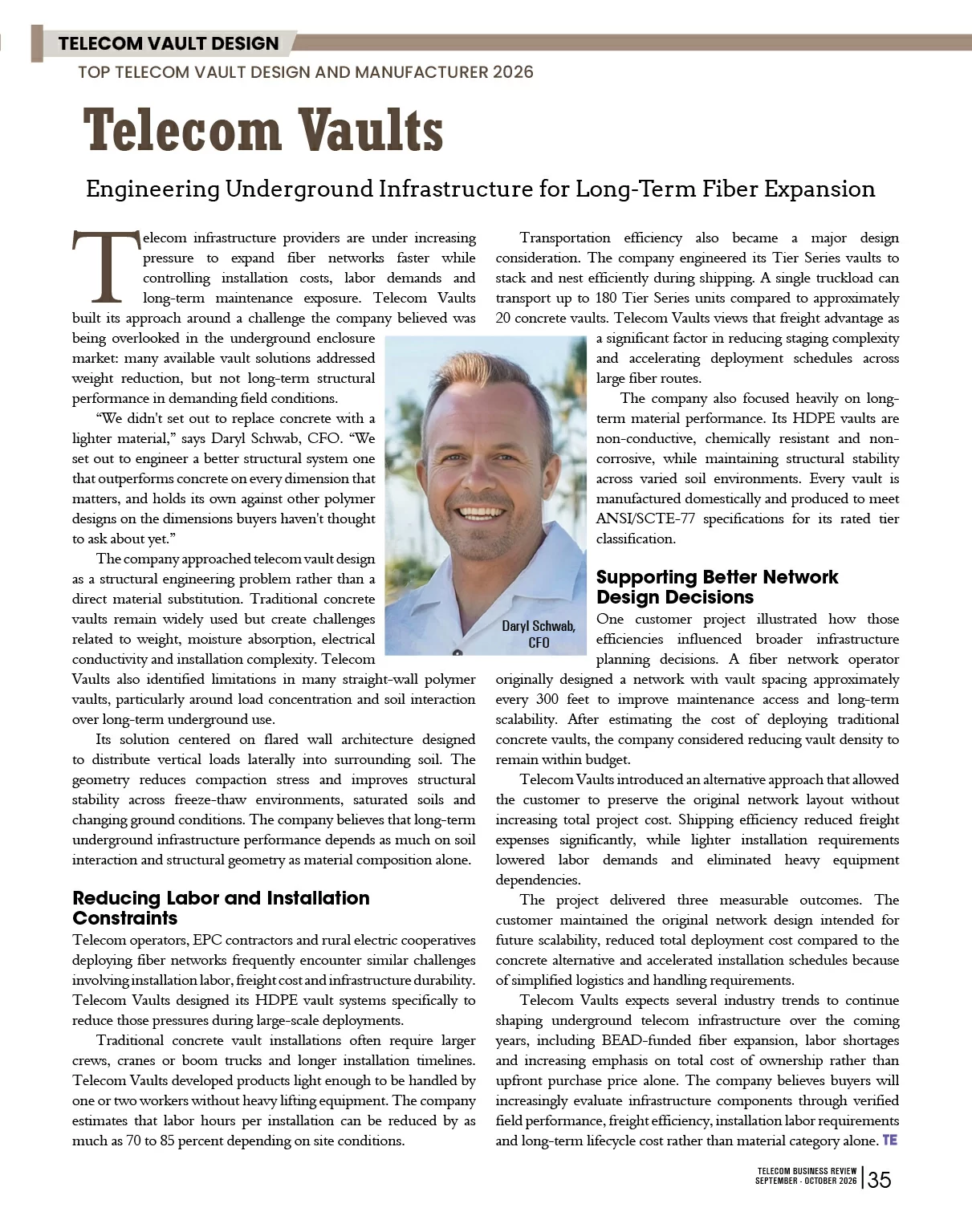
 Daryl Schwab, CFO
Telecom infrastructure providers are under increasing pressure to expand fiber networks faster while controlling installation costs, labor demands and long-term maintenance exposure. Telecom Vaults built its approach around a challenge the company believed was being overlooked in the underground enclosure market: many available vault solutions addressed weight reduction, but not long-term structural performance in demanding field conditions.
“We didn't set out to replace concrete with a lighter material,” says Daryl Schwab, CFO. “We set out to engineer a better structural system one that outperforms concrete on every dimension that matters, and holds its own against other polymer designs on the dimensions buyers haven't thought to ask about yet.”
The company approached telecom vault design as a structural engineering problem rather than a direct material substitution. Traditional concrete vaults remain widely used but create challenges related to weight, moisture absorption, electrical conductivity and installation complexity. Telecom Vaults also identified limitations in many straight-wall polymer vaults, particularly around load concentration and soil interaction over long-term underground use.
Its solution centered on flared wall architecture designed to distribute vertical loads laterally into surrounding soil. The geometry reduces compaction stress and improves structural stability across freeze-thaw environments, saturated soils and changing ground conditions. The company believes that long-term underground infrastructure performance depends as much on soil interaction and structural geometry as material composition alone.
Reducing Labor and Installation Constraints
Telecom operators, EPC contractors and rural electric cooperatives deploying fiber networks frequently encounter similar challenges involving installation labor, freight cost and infrastructure durability. Telecom Vaults designed its HDPE vault systems specifically to reduce those pressures during large-scale deployments.
Traditional concrete vault installations often require larger crews, cranes or boom trucks and longer installation timelines. Telecom Vaults developed products light enough to be handled by one or two workers without heavy lifting equipment. The company estimates that labor hours per installation can be reduced by as much as 70 to 85 percent depending on site conditions.
Transportation efficiency also became a major design consideration. The company engineered its Tier Series vaults to stack and nest efficiently during shipping. A single truckload can transport up to 180 Tier Series units compared to approximately 20 concrete vaults. Telecom Vaults views that freight advantage as a significant factor in reducing staging complexity and accelerating deployment schedules across large fiber routes.
-
We didn't set out to replace concrete with a lighter material. We set out to engineer a better structural system one that outperforms concrete on every dimension that matters.
The company also focused heavily on long-term material performance. Its HDPE vaults are non-conductive, chemically resistant and non-corrosive, while maintaining structural stability across varied soil environments. Every vault is manufactured domestically and produced to meet ANSI/SCTE-77 specifications for its rated tier classification.
Supporting Better Network Design Decisions
One customer project illustrated how those efficiencies influenced broader infrastructure planning decisions. A fiber network operator originally designed a network with vault spacing approximately every 300 feet to improve maintenance access and long-term scalability. After estimating the cost of deploying traditional concrete vaults, the company considered reducing vault density to remain within budget.
Telecom Vaults introduced an alternative approach that allowed the customer to preserve the original network layout without increasing total project cost. Shipping efficiency reduced freight expenses significantly, while lighter installation requirements lowered labor demands and eliminated heavy equipment dependencies.
The project delivered three measurable outcomes. The customer maintained the original network design intended for future scalability, reduced total deployment cost compared to the concrete alternative and accelerated installation schedules because of simplified logistics and handling requirements.
Telecom Vaults expects several industry trends to continue shaping underground telecom infrastructure over the coming years, including BEAD-funded fiber expansion, labor shortages and increasing emphasis on total cost of ownership rather than upfront purchase price alone. The company believes buyers will increasingly evaluate infrastructure components through verified field performance, freight efficiency, installation labor requirements and long-term lifecycle cost rather than material category alone.
Company :
Telecom Vaults
Management Daryl Schwab, CFO
Description
Telecom Vaults designs and manufactures HDPE telecom vault systems for fiber and underground infrastructure projects. The company provides engineered vault solutions focused on structural performance, freight efficiency, installation simplicity and long-term durability for telecom operators, contractors and broadband deployment programs.